A week or so ago my parents opened up their mailbox to find a check for $1,200 – meet their “economic stimulus” package from the government. Now that’s all good and well for my parents, they could use an extra $1,200 for all the home remodeling they want to do around the house; but, where’s my stimulus package?
Sexism and Hillary Clinton…please
Disclaimer: Yes I know the following information is out of date and Obama has secured the nomination. Yes, this is a political rant and rave. No, I am not some sort of expert of politics nor do I think I am. With that said…This was a blog post that I had on another site from May 22, but I felt like sharing it, because it’s my account and I can do that.
———-
Layman’s Gunpla Guide – Construction Guide
Welcome to the construction guide! The goal here is to review some of the basics of taking transforming that box of plastic runners into a proper Gundam kit. Beginners who have picked up their first kit have probably opened up the box, looked at the runners, than the Japanese instructions. How do you feel? Excited, maybe have a sense of tribulation? Well worry not!
Despite the number of small parts and the Japanese instructions putting together a kit perhaps the easiest part of the hobby.
Basic Terminology
Before we begin it’s important that you familiarize yourself with some of the common terminology. Those plastic things with all the pieces attached? Those are called runners. The parts of the runner which connect directly to the kit’s pieces are called sprues. When you cut a piece from the runner and sprue there will likely be a little piece of plastic left sticking out of the piece itself, that is called a nub.
Layman’s Gunpla Guide – Weathering Tutorial
Some people like their kits nice, clean, and pristine, Others like them looking like they just got kicked down a hill. Weathering can add detail from the subtle to the extreme depending on your preferences. The best part is that it’s extremely easy (and cheap) to do. It’s also a lot of fun. There are many different ways to weather a kit. Here are just a few.
Distressing Decals
It stands to reason that if your gunpla is getting worn down, so would the markings. This part’s easy. After you’ve fully applied your decals, simply scratch away with a toothpick. I think it adds character.
Layman’s Gunpla Guide – Top Coat Guide & Tutorial
Welcome to the top coat tutorial on the Layman’s Gunpla Guide. Top coating is an incredibly easy way to add an extra dimension to your Gundam model. Unpainted kits can look great with just a nice top coat while painted kits will gain that extra umph. Top coats also serve to protect the underlying paint and details while the difference between a matte and gloss finish can dramatically change the feel of a project. Top coats, especially a dull one, has the extra benefit of helping to hide the edges of any applied decals.
MG Ball, Vr. Ka
Master Grade for only $15? Well, it is just a Ball…
The Ball is probably the most under appreciated suit in Gundam. Cannon fodder way before the arrival of the GM. It’s single time to shine was that those brief scenes early on in the beginning 08th MS Team.
You can get a MG Ball for less than $15 and it shows. Not due to the build quality but because it’s such a small kit. At least a third of the instruction manual is nothing but pictures and information about the Ball. Of course none of it I can read, but it sure looks nice!
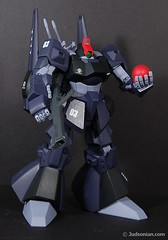
Master Grade Rick Dias
Layman’s Gunpla Guide – Buying Kits & Difficulty Grades
First timers might be wondering where exactly to start. There have been hundreds of kits released since 1980, if not thousands. Over the years the complexity and engineering has (generally) improved as Bandai’s production technologies and design methods advance.
Size and Scale
Gundam models, like most other plastic models have an accompanying original to model ratio, or scale. A 1/100 kit would be roughly 100 times smaller than actual size of the object the kit represents. A 1/60 scale kit would only be 60 times smaller resulting in a larger model.
Layman’s Gunpla Guide – Posing & Bases!
Probably the most important thing you can do after putting together a model is give it a pose. Add some life and personality to your kit.
Posing
It’s a rookie mistake, your Gundam shouldn’t stand around stiff as a robot. It should be allowed to loosen up as to look and feel more natural.
(click for larger, via ??? with thanks to /m/)
From here on everything is up to you. Reenact a scene, pit it in combat against another model, make it dance, facepalm, etc. If you’re working on your first kit with individual fingers, do what everyone does the first time, flip the bird. I really shouldn’t have to help with this part.
Layman’s Gunpla Guide – Decals & Stickers
[flickr-photo:id=13103543165,size=n] (Click to Enlarge)
Panel lining and top coats are simple and great ways to spruce up a kit. Applying decals is another great way. It’s simple, easy and a great way to customize your kit’s appearance. Most Master Grade kits come with a set of stickers and decals (either wet or dry transfer). Perfect Grade kits tend to come with a lot more (because of the size) and most HG do not come with any at all. The good news is there are quite a few third party decal makers out there in addition to basic detailing sets straight from Bandai.